Case study · 01
Multi-Channel Campaign Orchestrator
Turns one webinar idea into a coordinated, brand-consistent campaign across email, paid media and social—while keeping a marketer in control of the final launch.
System overview — a simplified portfolio diagram showing the governed path and human-control boundary.
At a glance
- Audience
- Demand generation, campaign operations and marketing automation teams
- Business problem
- Fragmented content production, inconsistent messages and separate approval processes across channels
- My role
- Business requirements, workflow architecture, cross-channel content model, validation logic and approval safeguards
- Validation stage
- Production-oriented architecture with the workflow structure and control paths reviewed; live adapters remain disabled
Project overview
Project overview
I designed a governed campaign-orchestration workflow that turns one structured webinar brief and shared brand profile into a master messaging pack, then adapts that message for Braze email, LinkedIn Ads, Google Ads, organic LinkedIn and additional organic-social formats. Validation, revision and approval remain connected through one traceable campaign version.
Business challenge
Business challenge
Webinar campaigns often ask email, advertising and social teams to recreate the same idea separately. The result can be duplicated effort, inconsistent claims, incorrect links and fragmented approvals.
How it works
How the workflow works
- 01
Validate the brief, dates, approved registration domain, budget and selected channels.
- 02
Create a master messaging pack and channel-ready assets with shared message lineage.
- 03
Apply deterministic checks for terminology, disclaimers, character limits, URLs and tracking.
- 04
Route blocking issues to revision and present the complete campaign as one approval package.
- 05
Bind approval to an immutable version and content hash before any configured adapter can proceed.
Designed value
Expected operational value
- Coordinates asset production around one approved message
- Surfaces preventable errors before review
- Gives the approver one complete campaign package
- Protects brand and budget with explicit activation gates
Responsible AI & human control
Responsible AI and human control
- AI supports drafting; it cannot approve or launch
- Hard validation sits outside the model
- Approval is tied to the exact reviewed content
- Paid resources remain draft or paused
- Four adapter paths are configured; additional organic social remains channel-ready content
My contribution
What I built and validated
I translated campaign-operations requirements into a 34-node orchestration architecture. I structured the brief and channel-output contracts, designed the cross-channel message-lineage model, implemented deterministic validation and revision paths, and created version-bound approval and content-hash safeguards before any configured platform adapter can proceed.
What I validated
- JSON architecture and 34-node structure reviewed against the business design
- Required-field, date and approved-domain checks represented in the workflow
- Revision routing and consolidated approval package represented
- Approval bound to the reviewed campaign version and content hash
- Four configured adapter paths identified: Braze, LinkedIn Ads, Google Ads and organic LinkedIn
Implementation evidence
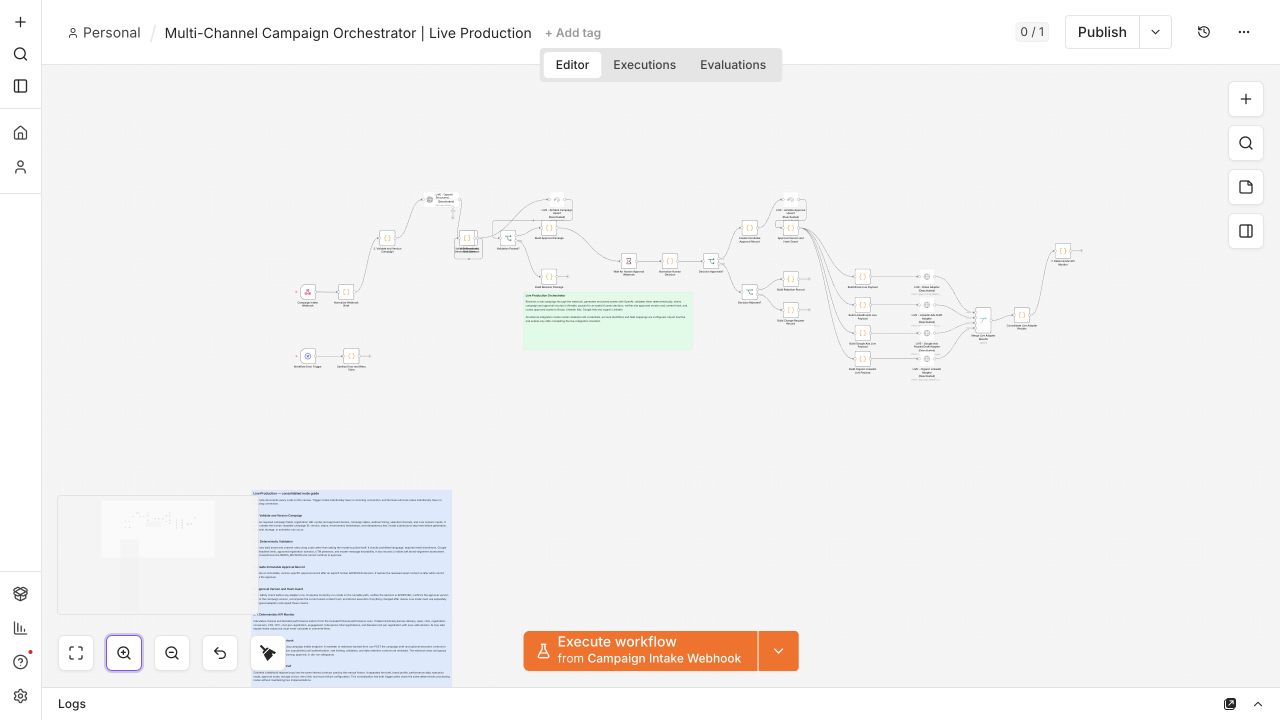
Current validation status
Production-oriented architecture · controls structurally verifiedThe workflow architecture and control paths are structurally verified. AI, Airtable and channel adapters remain disabled pending credentials, account mapping and controlled end-to-end testing. The additional organic-social package is currently a channel-ready content output rather than a connected publishing adapter.