Case study · 02
AI Lead Qualification & Journey Routing
Enriches new enquiries, calculates an explainable priority score and routes each lead to sales, consent-controlled nurture, future review or manual review.
System overview — a simplified portfolio diagram showing the governed path and human-control boundary.
At a glance
- Audience
- Marketing operations, revenue operations, demand generation and sales operations teams
- Business problem
- Incomplete lead data, inconsistent prioritisation and unclear follow-up routes
- My role
- Workflow architecture, data validation, enrichment handling, scoring logic, consent rules and system routing
- Validation stage
- End-to-end structure reviewed with safe mock defaults; live integrations remain unconnected
Project overview
Project overview
I designed an automated qualification and routing system that validates new enquiries, enriches relevant company information, assesses business fit and expressed intent, and calculates a transparent priority score through visible workflow logic. Airtable retains the evidence and selected route, while Slack and Braze represent controlled downstream actions.
Business challenge
Business challenge
New enquiries often arrive with incomplete information, leaving teams to research companies and prioritise follow-up manually. Valuable leads may wait, while inconsistent decisions and unclear consent can create risk.
How it works
How the workflow works
- 01
Validate and standardise the submitted lead data.
- 02
Enrich relevant company information with retry handling.
- 03
Give the model only the evidence needed for structured component scoring.
- 04
Validate the response and calculate the final score in visible workflow logic.
- 05
Route to sales, consent-controlled nurture, future review or manual review.
Designed value
Expected operational value
- Faster visibility of promising enquiries
- More consistent prioritisation
- Less repetitive company research
- A clear record of every automated decision
Responsible AI & human control
Responsible AI and human control
- Sensitive characteristics are excluded
- Consent is checked before Braze nurture
- Uncertain or invalid responses go to manual review
- Duplicate alerts and actions are suppressed
- Audit records are written before activation
My contribution
What I built and validated
I designed and configured the input-validation path, Apollo enrichment and retry handling, structured AI component scoring, deterministic final-score calculation, Airtable audit-first control and the final Slack, Braze, future-review and manual-review routes. I also incorporated duplicate suppression, consent checks, error handling and credential separation.
What I validated
- 61-node JSON structure reviewed, including 49 functional nodes and 12 documentation notes
- Safe mock mode and disabled external writes confirmed
- Apollo retry handling represented for transient failures
- Structured score validation and deterministic final-score calculation represented
- Consent-controlled Braze routing and manual-review fallback represented
- Airtable audit required before downstream activation
Implementation evidence
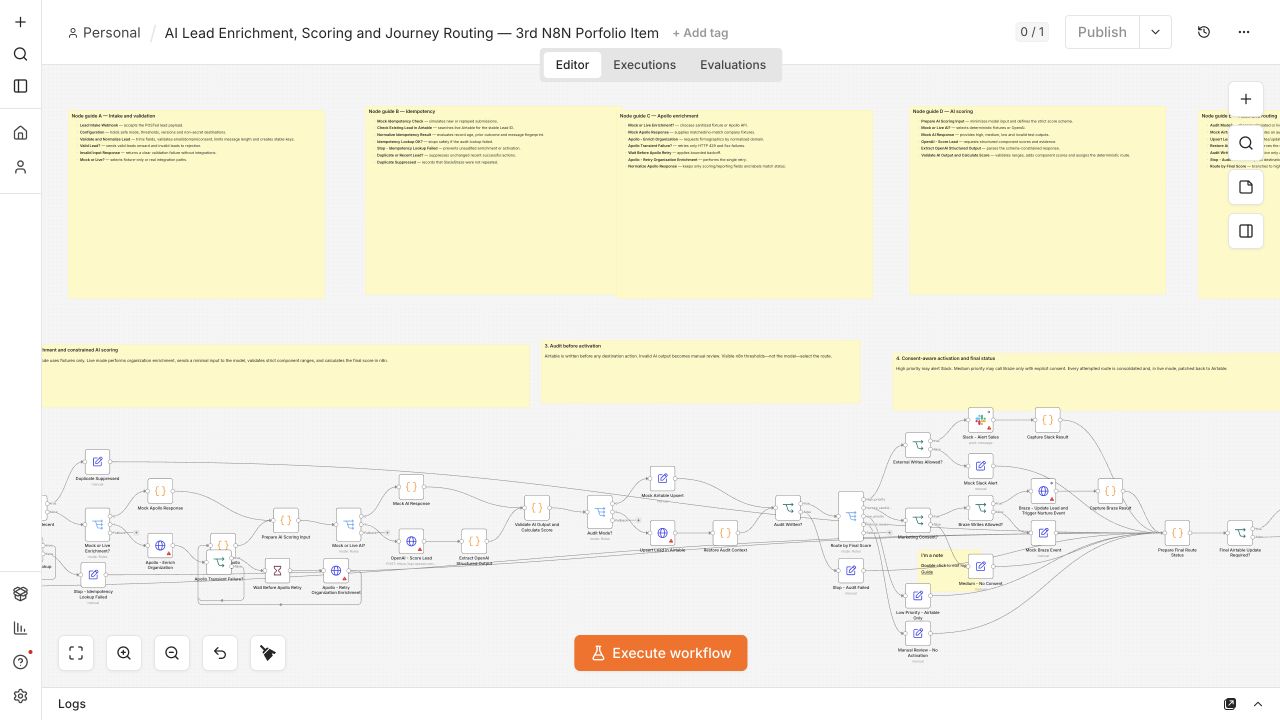
Current validation status
End-to-end workflow architecture · safe mock modeThe end-to-end workflow structure and safety controls are represented and structurally verified, with mock mode and external writes disabled by default. Live Apollo, OpenAI, Airtable, Slack and Braze execution has not yet been connected or reconciled against production systems.