Case study · 03
LinkedIn Ads Optimisation & Approval
Analyses Campaign Manager exports, surfaces evidence-based recommendations and converts only marketer-approved changes into a controlled implementation plan.
System overview — a simplified portfolio diagram showing the governed path and human-control boundary.
At a glance
- Audience
- B2B paid-media, demand generation and marketing operations teams
- Business problem
- Slow optimisation review, inconsistent decisions and the risk of acting on insufficient data
- My role
- Two-stage architecture, KPI calculation, minimum-volume safeguards, AI-output validation and approval handoff
- Validation stage
- Both workflow stages structurally verified in dry-run mode; no live campaign changes are made
Project overview
Project overview
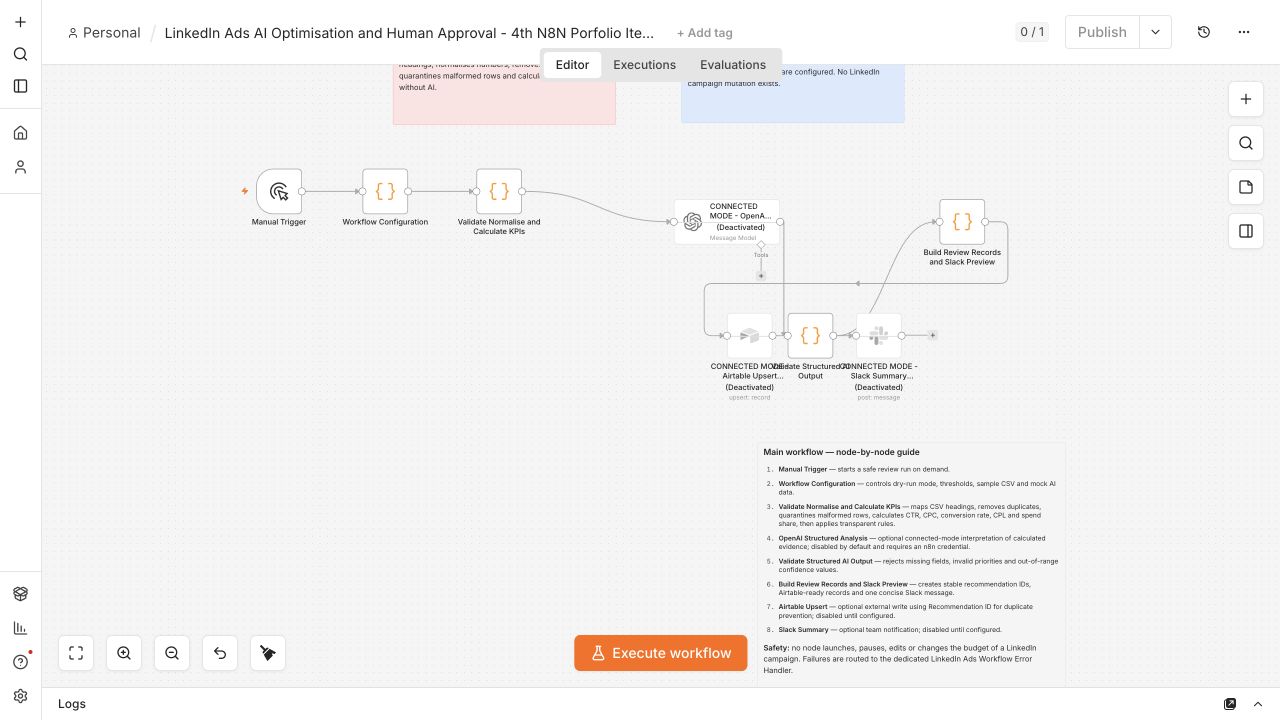
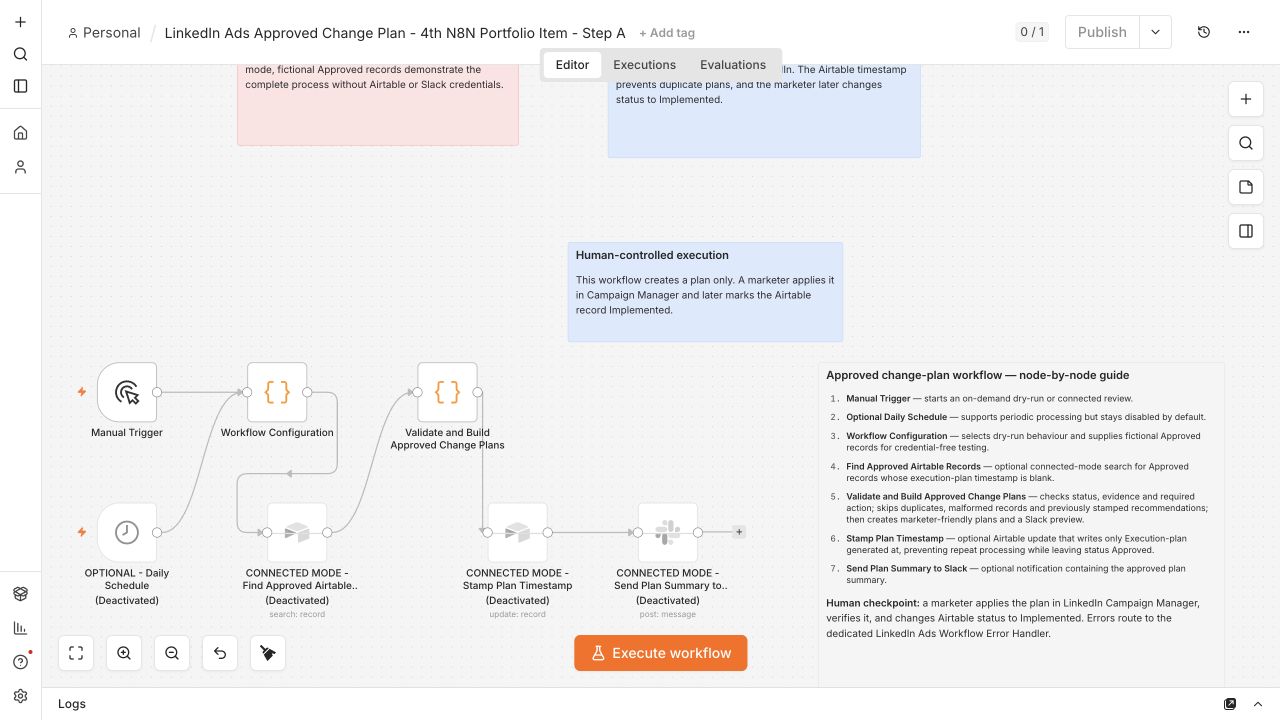
I designed a two-stage optimisation system. The first workflow converts Campaign Manager performance exports into an evidence-retaining recommendation queue. The second accepts only approved, complete and unprocessed records and turns them into a controlled manual implementation plan. The system never edits live LinkedIn campaigns.
Business challenge
Business challenge
Paid-media teams need to spot inefficient spend without judging low-volume campaigns too early or letting generated recommendations bypass brand, budget and quality review.
How it works
How the workflow works
- 01
Validate and normalise a Campaign Manager export.
- 02
Calculate comparable KPIs deterministically and apply minimum-volume safeguards.
- 03
Generate evidence-bound observations and proposed copy, then validate the schema.
- 04
Place each recommendation in Airtable with Pending approval status.
- 05
Accept approved, complete, unprocessed records and prepare a manual implementation plan.
Designed value
Expected operational value
- Surfaces potentially inefficient spend sooner
- Makes review more consistent and evidence-led
- Protects low-volume campaigns from premature judgement
- Retains professional control over spend and messaging
Responsible AI & human control
Responsible AI and human control
- Stable recommendation IDs
- Minimum-data safeguards
- Structured AI validation
- Airtable human approval checkpoint
- Duplicate-plan prevention and no live API changes
My contribution
What I built and validated
I designed and implemented both workflow stages, including export validation, deterministic KPI calculations, minimum-volume safeguards, structured AI-output validation, stable recommendation identifiers, Airtable approval gating and duplicate-plan prevention. I also defined the manual Campaign Manager handoff so spend and messaging remain under professional control.
What I validated
- Two separate 11-node workflows reviewed against the intended business sequence
- Malformed-row quarantine and duplicate-row removal represented
- Deterministic CTR, CPC, conversion rate, CPL and spend-share calculations represented
- Minimum-volume protection represented for low-data campaigns
- Pending and Approved status gates represented
- Duplicate-plan prevention and manual-only Campaign Manager execution confirmed
Implementation evidence
Current validation status
Two-stage dry-run design · structure verifiedBoth workflow stages and their control gates are structurally verified in dry-run mode. OpenAI, Airtable and Slack actions remain disabled pending private configuration and live validation. No live LinkedIn campaign changes are made.